

How to Counter-Map
Facing injustice and practising community resistance at Clissold Park

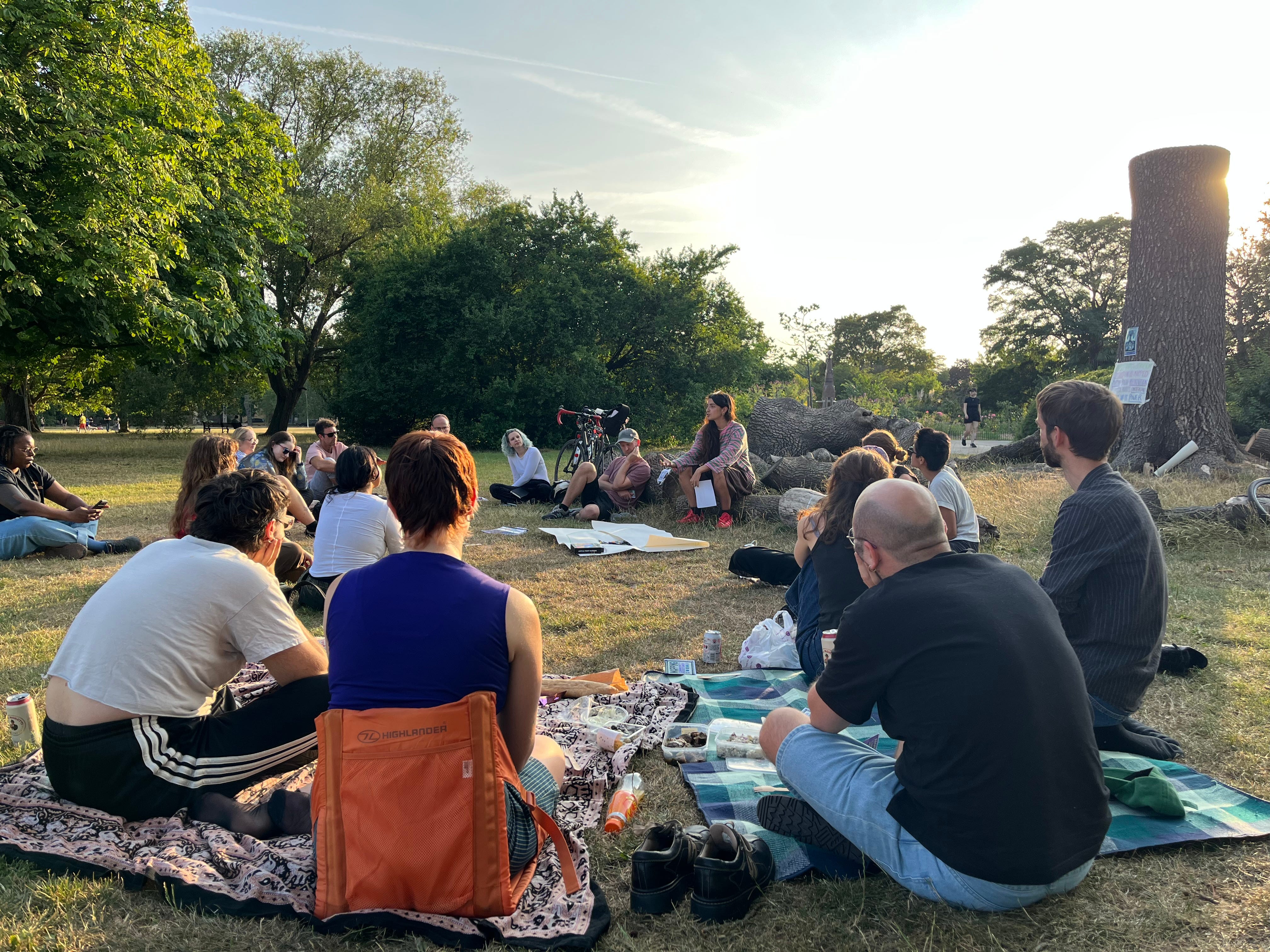
Yesterday I stood in Clissold Park with a stack of zines I had spent three weeks arguing with myself over, wanting to make fit into them years of love for maps, knowing that it would be a mission impossible.
The London School of Solar Punk runs something called Guerrilla lectures, a horizontal, non-hierarchical, diffused, DIY series of chats in parks. When I saw their open call, I immediately knew I wanted to give this a try, and I did not doubt what I wanted to talk about. I poured my heart and soul into making this lecture, and this piece is both a testament to the love of mapping that runs through my veins since I was a kid, the personal write-up of it of what a circle of strangers sitting on picnic blankets could produce together and a practical guide on how to fight the capitalist system through collective counter-mapping. For everyone to enjoy, to try, to fight.
Because mapping, and I am aware of how crazy I sound writing this, it truly is a matter of fighting. Especially now, that we are tired and scared. Living inside a permanent heatwave, facing injustice, the rise of fascism, racism, idiots leading countries, or hoping to be the next in line, promising to change our lives for the better by making someone else’s life worse, and the constant destruction of communities, of our common earth, and our sense of belonging.
We live in a constant state of tension. On one side, us, the people who live in a place and depend on it. On the other, the projects and policies decided for us, by someone who will never live with us. This is not an accident of capitalism, conflict is a requirement of it. Capital accumulation needs somewhere to displace its costs: extraction, pollution, exploitation, and that somewhere is rarely chosen democratically.
Communities absorb what elites externalise.
Out of that tension come two phenomena that need each other to be understood at all: an environmental conflict, which is what happens when a project imposes disproportionate ecological or social costs on a territory, and community resistance, which is the organised capacity of that territory to contest, defend or reclaim control over itself.
Community resistance is what makes friction visible.
The problem emerges when that resistance gets silenced instead, made invisible. Collective effort curdles into exhaustion. Anyone who has stayed in a movement or a grassroots community for more than a few years will recognise it on sight.
So how do we make invisible struggles visible again?
Mapping, or better, counter-mapping is one answer. It lets one struggle discover that another struggle, somewhere else, has already been fighting the same enemy under a different name and making injustice visible is, put plainly, a way of taking collective power back.
Mapping is a source of power, which is nothing new.
Since the sixteenth century, atlases have claimed to show the world as it really is, serving power, the state, the market and the science built to justify both. An example is the 1570 Theatrum Orbis Terrarum, which claimed that sea monsters lived in the ocean between Japan and North America to hide their lack of knowledge, or school atlases that have taught generations to see the nation-state in the Mercator projection, with Europe in the middle, and northern countries way bigger than what they actually are, to hide in plain sight power relations.
Counter mapping is something else. Is what the editors of This Is Not an Atlas, a book I brought a printed copy of during the talk and which is also sitting open source here, call
A political practice of mapping back
The term itself is only thirty years old, coined in 1995 to describe how Dayak communities in Indonesian Borneo used cartography to reclaim land the state had already decided was not theirs. There is a line the book quotes worth repeating:
More territory has been claimed by maps than by guns, and just as much can still be reclaimed the same way, from whoever currently holds the money, the pipeline, or the construction permit.
Counter mapping, then, is not map-making in general. It is map-making that pushes back against whoever usually holds the pen, and the strange, freeing part is that it does not have to look like a map at all.
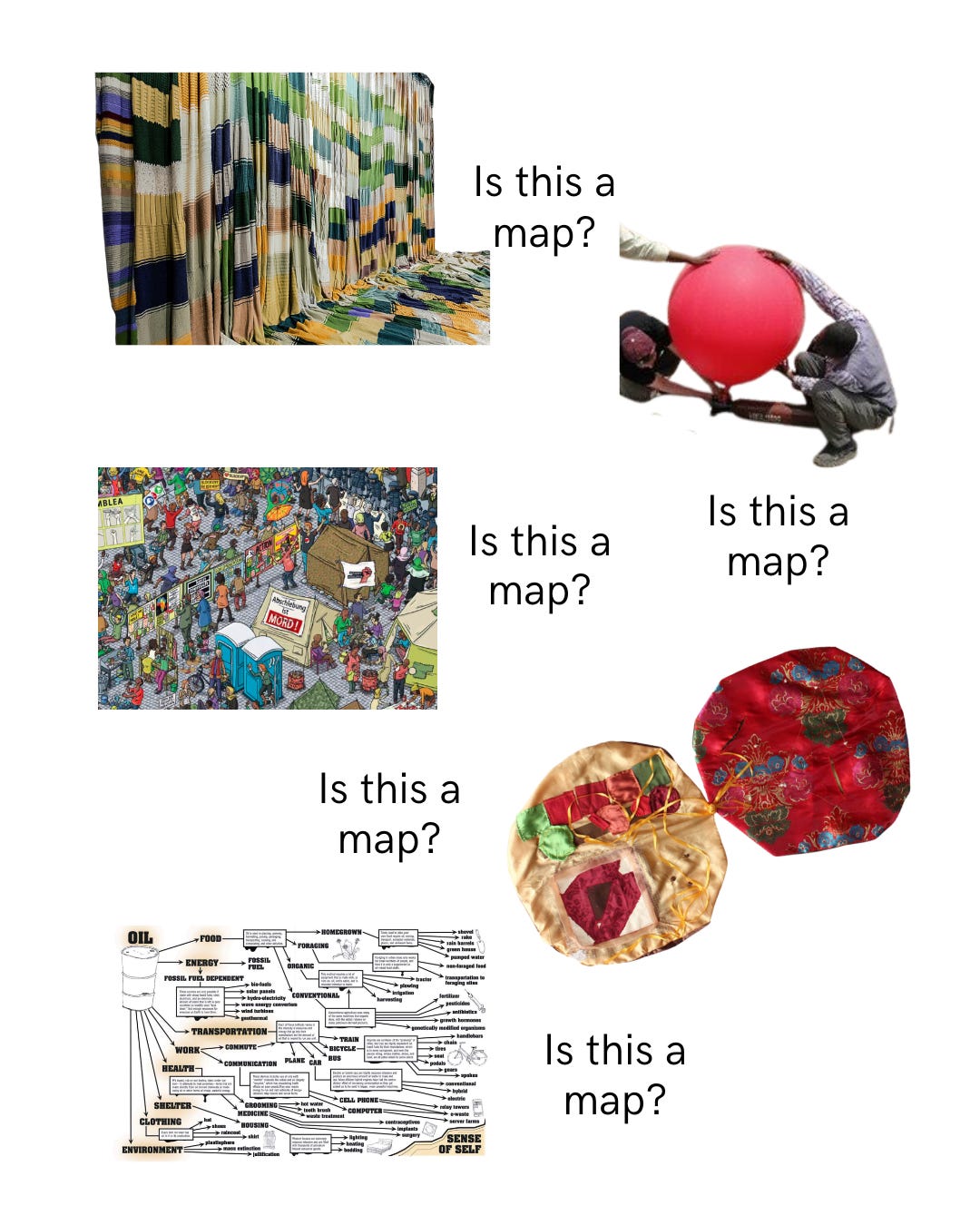
A textile map, woven or stitched onto fabric, where every stitch is a decision the group had to make together, slowing everything down on purpose. A balloon map, a camera lifted on a helium tether and stitched afterwards into an aerial image with open source tools, useful anywhere drones are restricted or banned, which is increasingly everywhere. A deep map, dense and deliberately nonlinear, folding history, memory, oral testimony and ecology into the same page and letting contradictory accounts sit next to each other without asking them to agree.
The strongest example of a countermap is Keine Angst by Danger Danny. A protest song, mapping the exact ways in which we could fight dirty fascists and pigs. The actions we could do, where to do them, pubs, streets, and who to do them with.
Please, please, please, have a read.
Don't be afraid, don't be afraid, don't be afraid, don't be afraid
First, call one or two people you trust
People you can rely on, and set up a meeting
You'll start a group that doesn't have a name
No founding date, and definitely not an association or any of that nonsense
Talk to bars and pubs, ask if they'd be willing to host
A party against Nazis for one night
Invite your friends to a little festival
DIY, free admission, collect money through donations
With the money you earn, buy spray paint cans
Buy stickers and markers, make sure everyone sees
You're sick of fascists, and this is your city
Don't get caught, watch out for surveillance cameras
Never go without gloves, never leave a fingerprint
And definitely never film or take a photo of it
Only tell those who were there about the actions
This is about leftist street activism, not fame
You need rules for communication
Not just Nazis and their cronies who live in your neighborhood
The security agencies will take an interest quickly, too
From the very start, you must communicate everything in secret
That means: no DMs, no messaging apps, and no emails
Anything that could be illegal, always face to face
Leave your cell phone at home because of movement profiles
And if they catch you: don't talk to them
(Discalimer: this song was suggested during our chat in the park; before writing, I looked into the lyrics and the band’s reputation, but I wasn’t aware, and it was pointed out to me, that there is apparently a controversy in Germany linked to this band. In this context, the lyrics remain linked to what I believe is a sound approach to collective organisation. If anyone would like to look into this further and help me understand just how far-reaching the controversy actually is, just get in touch :))
These are counter maps. Serving our people. Serving our power.
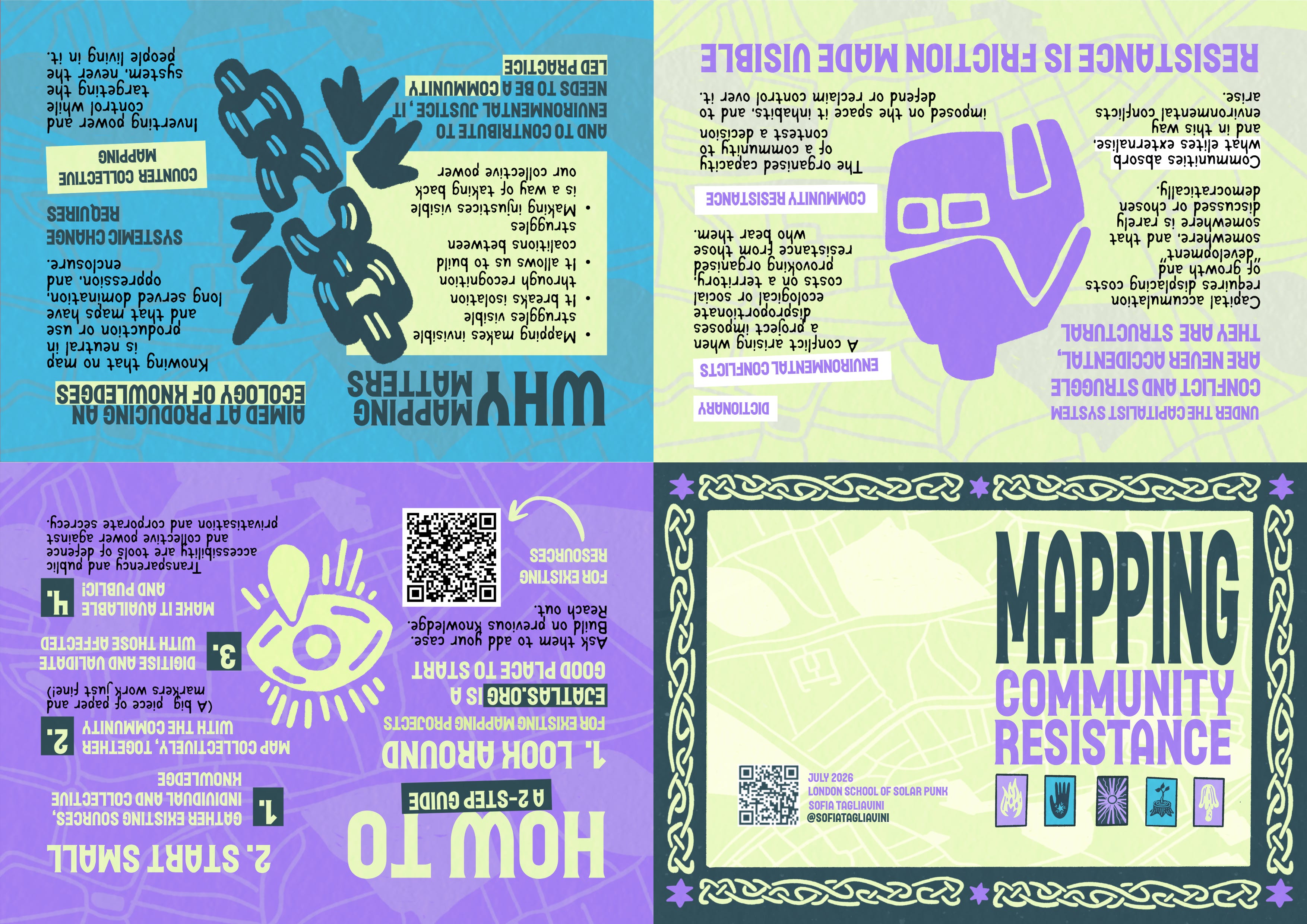
Whatever form it takes, a counter map does four things for our communities:
It creates visibility, because a condition nobody can point to is a condition that is very hard to organise around.
It shows spatial subjectivity, personal archives, songs, oral memories standing in for the one official version, so that no single account gets to dominate.
It works as self-reflection, since a community has to produce its own account of itself before it can fully understand what it already knows collectively
It works as critique, exposing a structural imbalance that words alone tend to flatten, to hide, giving all the power to the rich and the corrupt.
That last one is what a girl named Caro asked me about afterwards, though she phrased it as a question about unlearning. What had I personally had to unlearn, in years of doing climate activism? Ego, I said, before I had time to polish the answer. That I am not the centre of it, that I am not the subject. That as a child I believed I would personally solve the climate crisis, become someone capable of it single-handedly, and that belief is one version of what Boaventura de Sousa Santos calls abyssal thinking, everything sorted into right or wrong, individual or collective, success or failure. What is actually happening is closer to an ecology of living beings, of people, of knowledge, than to a binary anyone gets to win alone. Mapping is a technology of recognition. Recognition enables convergence. Convergence builds power.
So how do we actually counter map?
Two ways to begin, and they are not mutually exclusive.
1. Look at what already
A reading list and a set of manuals live in this folder. This Is Not an Atlas among them, the Iconoclasistas manual alongside it. For digital platforms already documenting conflicts at scale, the one I would point you to first is
The EJAtlas
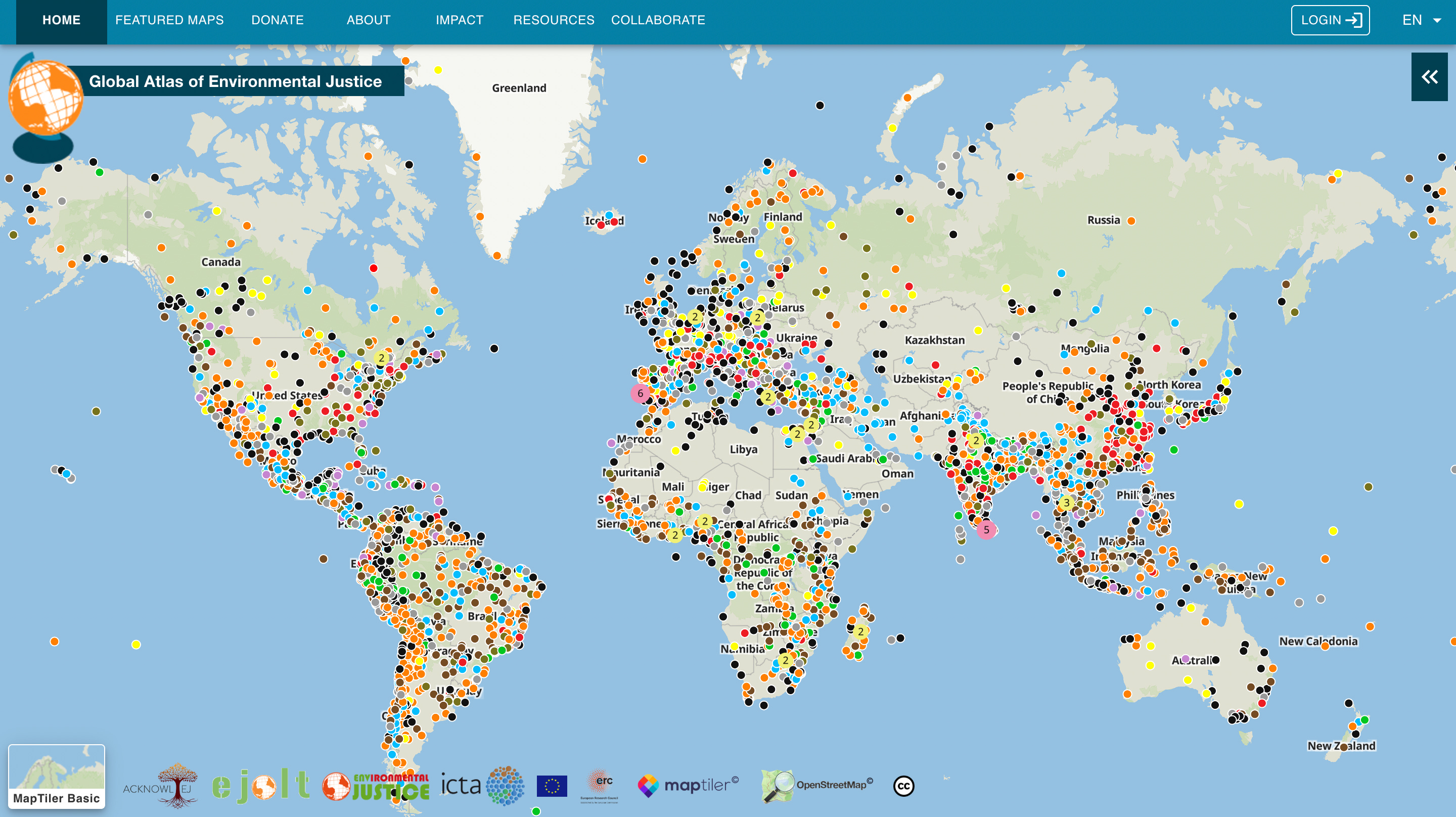
which I personally research for and did not shut up about yesterday: 4,562 environmental conflicts mapped so far and still growing, each one classified by typology, each one carrying the associations and local alternatives already fighting it. If you are inside a grassroots fight against a data centre, an oil rig, a mine, this is the actual resource, not a nice-to-have, a way of learning from other people’s wins and losses and getting in touch with whoever is already doing the work near you. And if you know of a conflict that has not been mapped yet, that you want mapped, get in touch with me, or through the website. I mean that literally, not as a sign-off.
2. Start your own
It does not need to be complicated, a physical map on a wall or a shared pin list will do, built through four repeatable stages:
gathering the sources that already exist
mapping collectively with the people affected
digitising and validating what comes out of that with those same people
then making the whole thing public.
Transparency and public accessibility are tools of defence and rebellion against privatisation and corporate secrecy.
The Iconoclasistas manual, is the practical companion for the session itself, room setup, materials, timing, how to actually run it without over-explaining the rules to death.
Last night at Clissold Park, when we stopped talking about all this, we started getting our hands dirty. Everything I had just described is a practice, not a lecture topic, so with no printed street map, the obvious literal cartography was never really available to us anyway, and we built a constellation map instead.
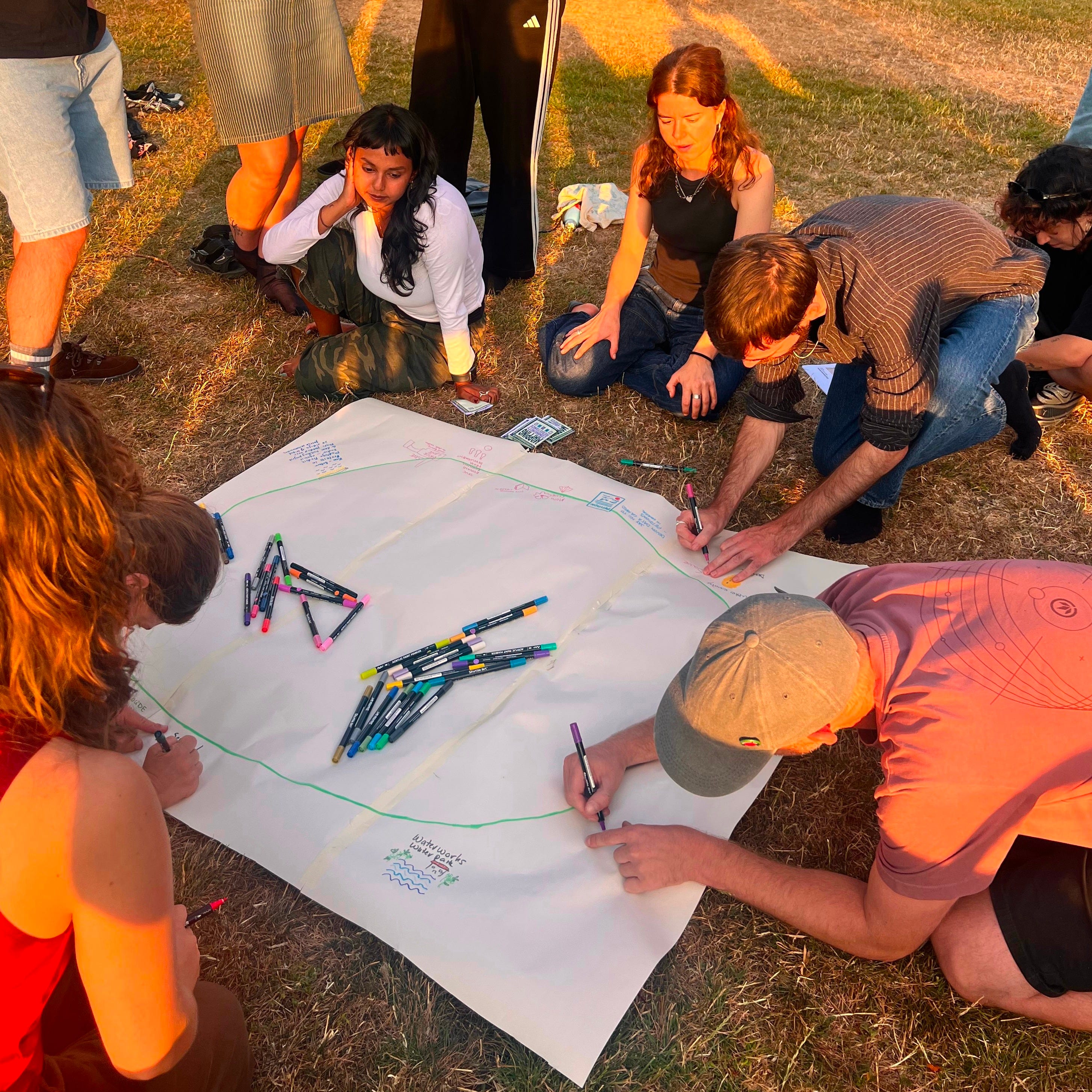
Everyone added one node, a conflict, a resistance, or an alternative they personally knew of, a word or two and a symbol invented on the spot. Once we had close to twenty nodes, people drew lines between the ones that shared something, the same company, the same tactic, the same outcome, and named the line with what it was. I was meant to circulate and prompt rather than facilitate from the front, and mostly managed it, though somewhere in there I stopped managing anything at all.
Someone folded a corner of the paper so one connection could physically meet another, which a flat page is not supposed to allow, and the map went from two dimensions to three without anyone announcing it. A dog appeared, uninvited, walked straight across the middle of the constellation, and someone drew its paw prints in afterwards rather than scolding it away, which felt correct.
That is when Poorva, whom I had only just met, showed me Forensic Architecture’s investigation into the killing of Hind Rajab, the way violence gets reconstructed second by second from fragments until the reconstruction itself becomes evidence, and for a moment the room was mapping something none of us had put on the agenda. Annabel, who runs a zine library, asked to add mine to it before the afternoon was even over.
Somewhere in the middle of it someone asked me whether I had been obsessed with maps as a child. Yes, obviously yes, though it took a stranger in a park to make me say it out loud. Someone else asked what my dream mapping project would be, and I answered before I realised what I was saying. This. Mapping resistance, exactly as I was doing it that evening, would have been a dream a few years ago. Now it is simply what I do. Though if we are still dreaming, I would map every oil field on the planet onto one collective, constantly updated map, with a second layer of dots for every disaster and every socio-environmental conflict tied to each site of extraction.
Someone would have to fold that map too, eventually, for all its connections to meet.
I planned on closing by asking people which node had ended up with the most connecting lines, and what that told us, but I realised I was not even sure it is the right question. The interesting node might be the one furthest from the centre, unconnected to anything, sitting there the way an unmapped conflict sits, present but not yet recognised as part of any pattern.
Sitting here now, in front of a folded, paw-printed piece of paper that used to be flat, I am less sure about many things but certain of how important it is to start challenging every single thing, especially the ones imposed to us.
The system. Its maps. Its power. Its projects.
The oil fields, the data centres, the new malls, the oppression, the silencing.
Everything from yesterday- the full reading list, the manuals, the EJAtlas link, the zine itself, pictures of the final map we made - is here, for anyone to use.
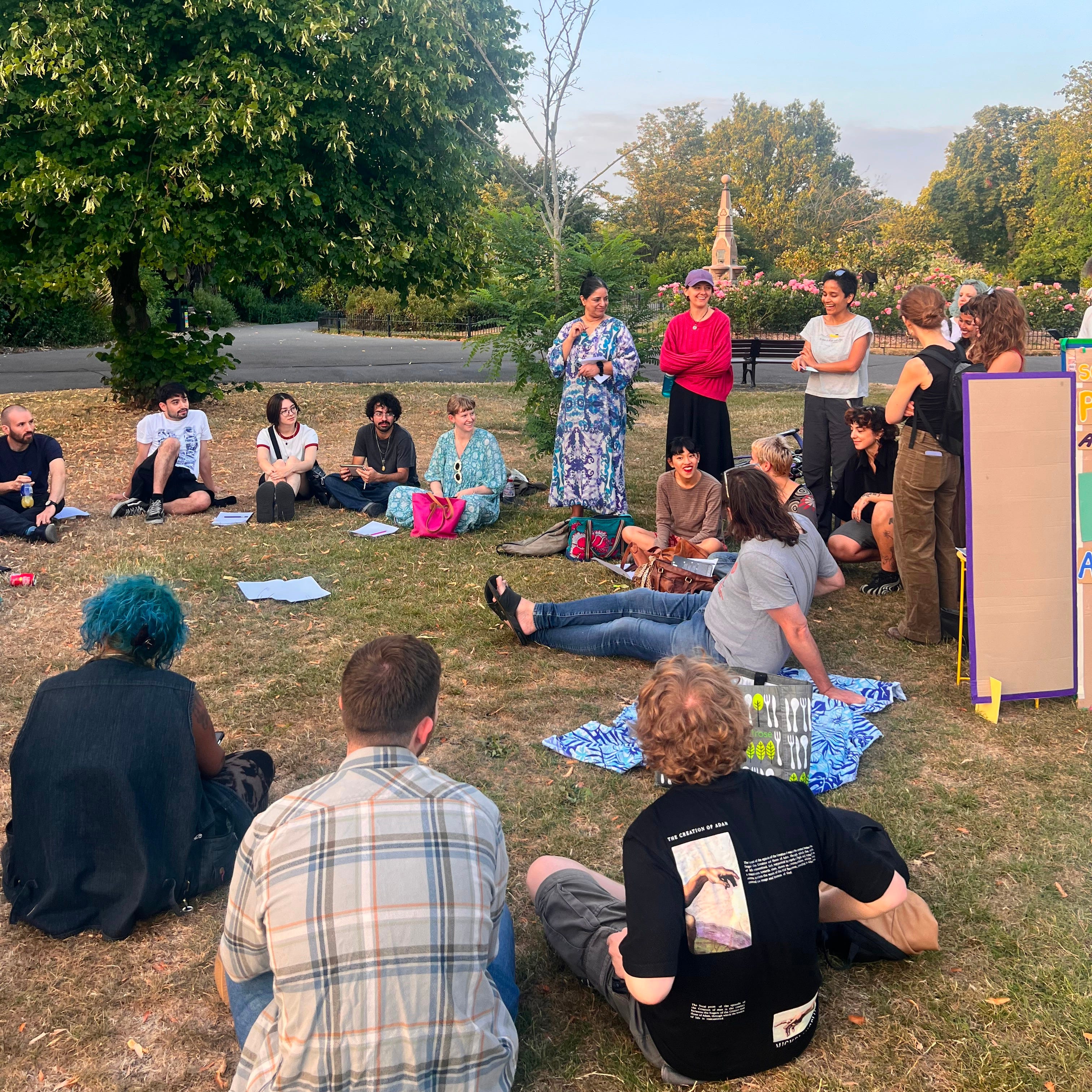
Thanks for reading this unusually long piece, part of my Substack and Instagram series on How to Rebel Against the system. Thank you to the London School of Solar Punk, to Oli, Alyiah, Caro, Poorva, Fran and anyone who joined us.
If you are reading this, if you were in Clissold Park yesterday, or if you know a conflict that has not been mapped yet, or you just want to have a chat, please, please, reach out <3
thanks for this. The link to the resources seems not to be correct. This is what's link: https://forensic-architecture.org/investigation/the-killing-of-hind-rajab - can you please share the link to the resources and materials?
This is so good! Thank you for writing this up. One thing tho, the link to the completed map goes to the aforementioned Forensic Architecture project. Would be amazing to be able to see the completed map as well as this link. 🙏